
Q&A with Coach Brian Fogg, Practical Self-Defense
Tectonic Times
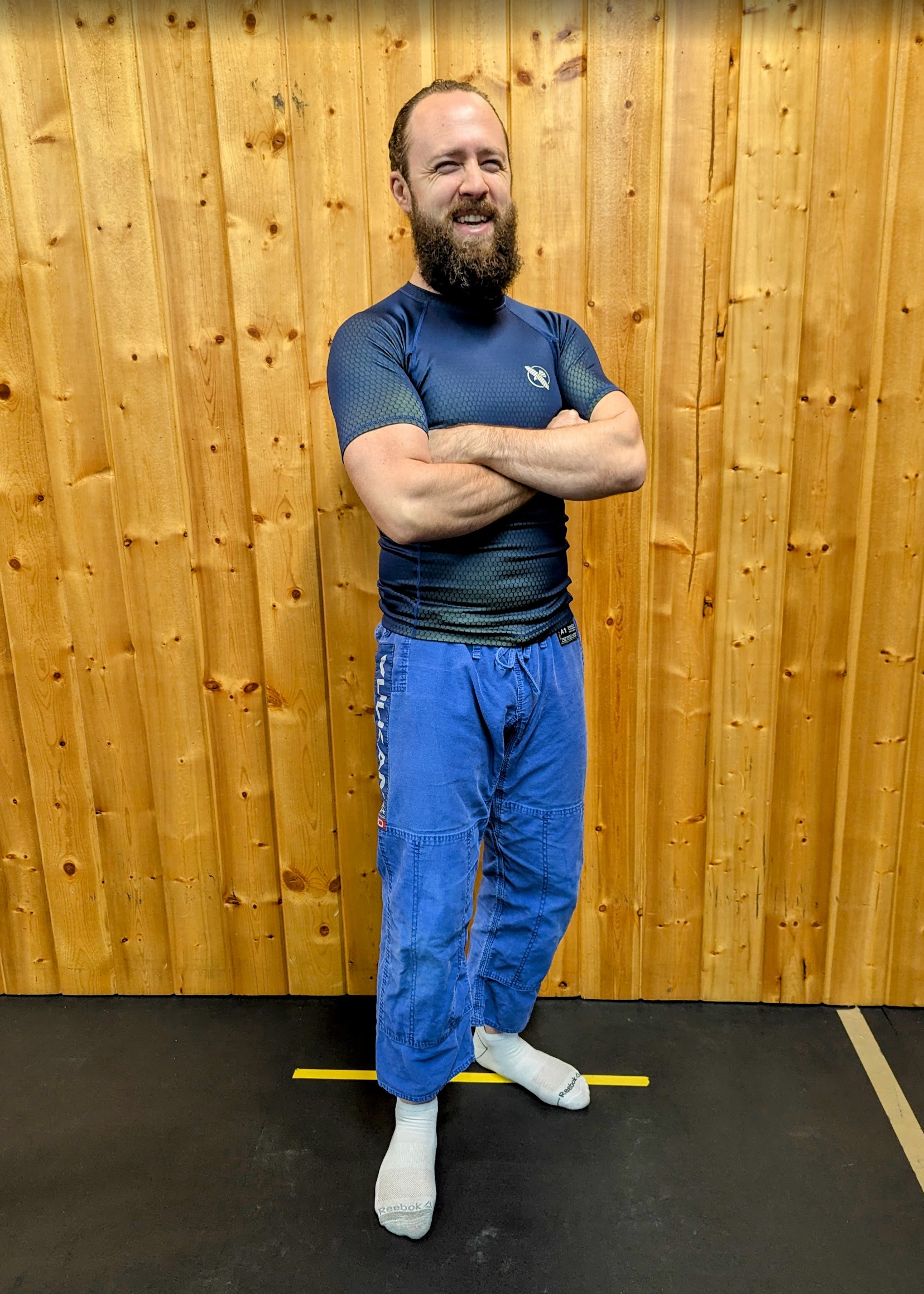
If you’ve attended a Sunday Practical Self-Defense class, you already know Coach Brian Fogg’s brain offers a depth of understanding that can only be earned through many years of week-in-week-out training, discipline, application, and experience.
But just how deep does his martial arts roots go?
Enjoy the below Q&A to learn more about the man behind our self-defense program, his journey through multiple martial arts, and why he believes the mental game matters just as much as the physical one.
Born Out of Necessity
Q: So how did you get into martial arts?
Brian: My older brother, who’s 5 years older than me, started training and then he started practicing on me. He’d put me in an arm lock and walk me around the house. I told my mom, “Hey, this isn’t fair.” So she signed me up too. I was 7. And I just kept going. I never really decided to say no to it. By the time I was 13, I had my black belt in Shaolin Kempo.
Q: So this passion was born out of necessity?
Brian: Oh yeah. Part of it was just so I could do something about my brother practicing on me other than just my mom saying, “Don’t do that.” I kept with it, and during my college years I was teaching Kempo Monday through Saturday, 36 hours a week.
Four Martial Arts and Counting
Q: How many martial arts do you know?
Brian: I’d say I’m proficient in Kempo karate and Brazilian Jiu Jitsu, since those are the ones I have legitimate ranks in. I’ve got 4 stripes on a black belt for Kempo, and I got up to a purple belt in Brazilian Jiu Jitsu. I also dabbled in Shaolin Kung Fu for a couple years, plus a couple years of Krav Maga.
Q: What was Krav Maga like compared to everything else?
Brian: A big eye opener. With Kempo and Kung Fu, the mindset is disengage, conserve your energy, find the easier path out. But Krav Maga? Their whole deal is you attack aggression with overwhelming aggression. Like, “Oh, you’re going to come after me? I’m going to throw 12 elbows at your face by the time you get close.” It just wasn’t my speed. I’m not an aggressive guy. If I’m in a scenario, I’m going to want to find an easier path out rather than, “Okay, you have no more teeth.” That’s just not me.
It’s Mostly a Mental Game
Q: What’s the most underrated part of self-defense training?
Brian: It’s mostly a mental game, and that only really comes with repetition. You can train your kicks to perfection, but if you’re in a scenario where someone is on top of you, you’ve got to be able to recall that. There’s a phrase my Kempo instructor used to say: “Practice doesn’t make perfect, practice makes permanent.” If you’re practicing for a bad scenario and how to get out of it, you’re going to recall that in the moment much more effectively than, “I got this one kick. I can kick the punching bag real hard, but what do I do if I miss?”
How Many Belts is 50 Pounds Worth?
Q: If someone’s big and strong but has zero skill versus someone small but highly skilled, how do you think about that?
Brian: That’s a very common thing to talk about, especially in the Jiu Jitsu space. I’ve heard people say that for every 15 to 20 pounds someone has on you, that’s another belt level in difficulty. You’ll notice if you get a brand new white belt who’s 250 pounds and yoked going against a guy my size, 170 on a good day, but with a purple or brown belt? The smaller, more experienced fighter will run circles around them. They know how to use not only their weight, but their opponent’s weight against them. Technique in the end will take you pretty far, even if you don’t have the size.
Self-Defense, Not Fighting
Q: Of all the martial arts you’ve trained, what’s most useful for everyday self-defense?
Brian: Definitely a mix of all of them. But the main source is Kempo, because it has a better mindset for what a typical person should have. I’d much rather go down the self-defense direction. The defense is the keyword in that. Different connotation than a fight. I’d rather teach people, “How can I control myself in this?” rather than “How do I dominate this?”
Q: So self-defense doesn’t have to be physical?
Brian: Not necessarily. If you’re in a room and you see something might be happening, you don’t need to be there. Can I get myself, can I get my family out of here in a safe way? That’s a completely viable option. It’s mostly situational awareness, which does come with training in self-defense. You start to recognize body language, you can start doing the calculation faster. “Can I help? Am I in a position where my actions would help or hinder?” That’s a big part of it.
What to Expect on Sundays
Q: How are you structuring the self-defense program?
Brian: We started the very first class with body awareness. How do you fall down and not risk injury? How do you stand back up when someone’s around you? That’s always the first step. From there, we moved into stand-up self-defense, strikes, punches, kicks, because that’s where most encounters start. My plan is to go into stand-up grappling next, things like grabs, throws, and takedowns. Then we’ll take all that to the ground, which is typically the worst case scenario but also where a lot of encounters end. Most of them start standing, most of them end on the ground. Once we cycle through all of that, we’ll keep rolling through it so it builds over time.
Practical Self-Defense with Coach Brian Fogg
Every Sunday at 11:15am | Open to all members, alumni, friends & fams
Come learn, train safe, and become a little more prepared.